- Differentiation between OBD-II diagnosis and oscilloscopy to avoid unnecessary part replacement.
- Analysis of available formats: USB devices, portable tablets, and high-resolution laboratory oscilloscopes.
- Critical applications in the workshop: distribution synchronization, CAN Bus networks, relative compression and ignition.
- Importance of protective accessories such as attenuators and capacitive probes to prevent damage to the equipment.
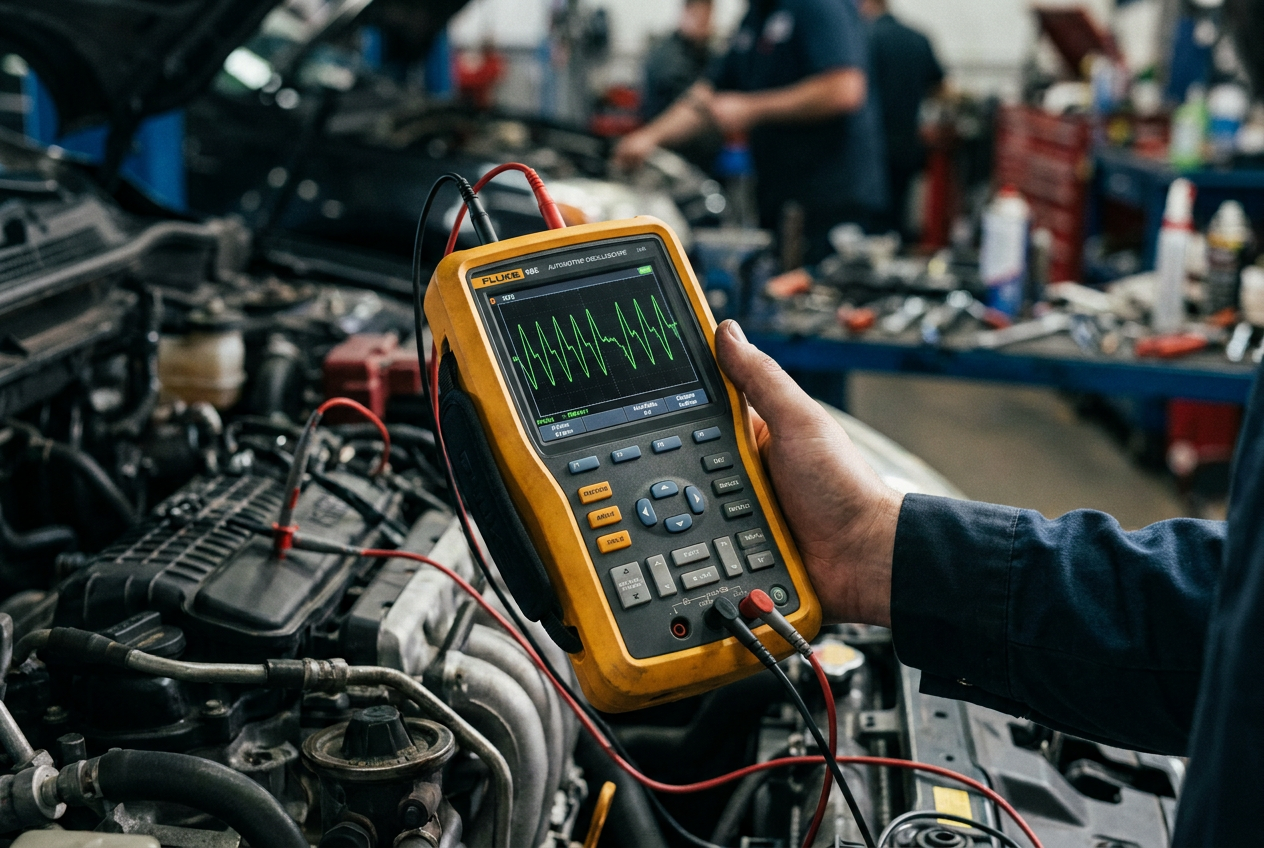
When it comes to diagnosing a car these days, many people only use an OBD-II scanner. But let's be honest, reading error codes is like reading the index of a book without opening the pages; it tells you there's a problem, but it doesn't tell you exactly where the fault is or why it's happening. This is where the automotive oscilloscope comes in, a tool that allows you to see what's happening in the wiring in real time, preventing the mechanic from guessing and replacing parts by trial and error.
Mastering this equipment in the workshop represents a significant leap forward. While standard diagnostics alert you that a parameter is out of range, the oscilloscope allows you to capture the actual waveform in microseconds . This is crucial for differentiating whether the problem is a faulty sensor, a corroded cable, or a problem with the engine control unit (ECU) itself in its power stage.
Which equipment should be chosen based on the pace of work in the workshop?
Not all oscilloscopes are created equal, and the choice depends entirely on how you navigate the engine compartment. Basically, there are three options depending on the convenience and precision you require:
- USB PC Devices: They're ideal if you prefer to analyze everything on a large screen. Since they don't have their own screen, they connect to a laptop, which allows you to... compare overlapping curves and archive captures detailed in the customer's information sheet. For example, there are simple 8-channel options for slow sensors, while more powerful 70 MHz models are needed to analyze fast communication networks.
- Portable and Tablet Formats: To avoid having your laptop propped up on the car's fender (with the risks that entails), touchscreen tablets are a lifesaver. They have integrated battery and optimized menusThis allows for road tests with a co-driver to identify those faults that only appear when the engine is hot or when accelerating.
- Laboratory and High-End Equipment: For in-depth expert analyses or diagnoses, equipment with high-resolution A/D converters (12 to 16 bits) is used. These instruments offer step-by-step wizards and databases of pre-recorded signals, being vital in heavy vehicles or agricultural machinery where galvanic isolation and robustness are mandatory.
Essential tests you should perform with the oscilloscope
If you want to get the most out of the equipment, there are checks that are commonplace in modern electromechanics:
One of its most powerful uses is timing control . By measuring the crankshaft position sensor (CKP) and the camshaft position sensor (CMP) simultaneously, you can determine in ten minutes whether the timing chain has stretched or if the variable valve timing is off, without having to remove any covers.
It's also the ultimate tool for analyzing injectors and ignition coils . Using a clamp meter, you can view the current ramp and detect if the injector needle is physically moving or if a coil has an internal short circuit. Furthermore, it's key for checking multiplexed networks like CAN Bus or CAN FD , instantly detecting short circuits to ground or a missing 120 Ω terminator resistor.
Another master trick is the relative compression test . Without removing spark plugs or injectors, you measure the electrical current draw of the starter motor; a lower current peak in a cylinder immediately reveals a burnt valve or worn piston rings. And if you work on motorcycles, it's essential for checking the pickup coil, the CDI module , and ensuring the three-phase alternator is rectifying the current correctly.
Key accessories to avoid damaging the equipment
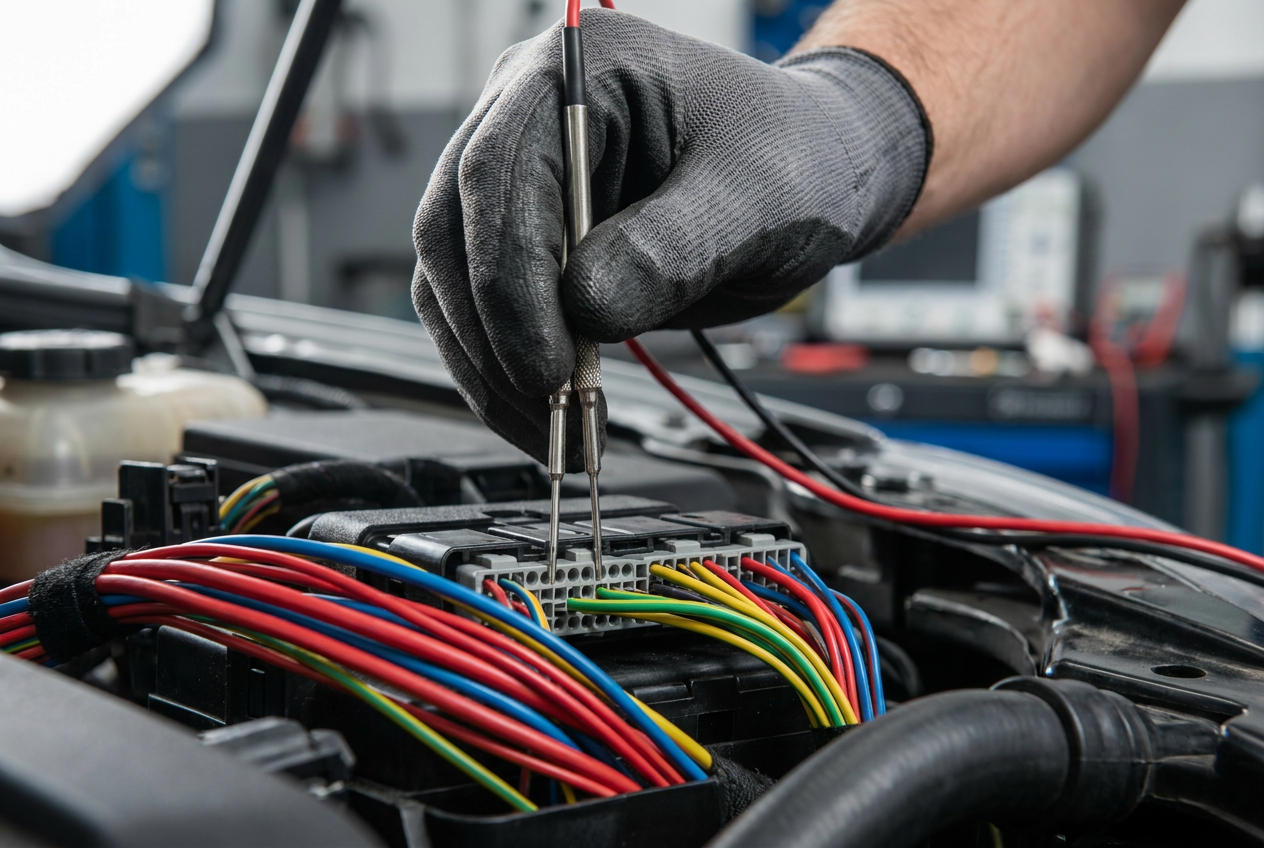
Connecting an oscilloscope to a motor is dangerous without the proper accessories. The 20:1 passive attenuator is essential, as it protects the device's input by absorbing voltage spikes of up to 400V generated by the solenoids or coils.
To measure current, we need clamp meters of different ranges : low-range clamps for injectors and high-range clamps for relative compression. To avoid damaging the wiring, back probes are best , as they allow you to pierce the metal terminal without breaking the insulation. Finally, for the spark, a capacitive probe is used , which captures the ionization voltage without direct electrical contact.
For the most demanding professionals, there are touch models with LIN, FLEXRAY and CAN protocol decoding , which reach bandwidths of up to 300MHz and deep memories, ensuring that no signal, however fast, goes unrecorded.
Having a tool like this, complemented by protective accessories and the appropriate software in Spanish, transforms the way work is done in the workshop. Moving from guesswork to visual evidence of the electrical signal allows for fast, precise, and professional vehicle repairs, eliminating uncertainty in diagnosing complex electronic faults.