- Cloudflare is a global platform that combines CDN, security, DNS, and developer services, acting as an intermediary between users and origin servers.
- Its network of distributed data centers reduces latency and offloads work to the server, speeding up website loading and mitigating DDoS attacks and other threats.
- Cloudflare's massive adoption means that its outages or blockages impact thousands of services, making it seem as if "half the internet" has gone down.
- Its central role also generates controversies about neutrality, use by illicit actors, and judicial blockages, which sometimes affect legitimate services as collateral damage.

You've probably encountered the dreaded 502 Bad Gateway message at some point. When you try to access a website you use daily, everything seems broken, pages won't load, and it feels like "the internet is down." In reality, many of these outages have a hidden culprit: Cloudflare, a piece of infrastructure so widespread that when it catches a cold, half the internet catches a fever.
Cloudflare has become one of the major intermediaries between users and websitesThis is an actor that speeds up website loading, protects them against cyberattacks, and manages a significant portion of global internet traffic. It's so crucial that when it fails, services like Discord, Twitter, League of Legends, Spotify, banks like CaixaBank, or even platforms like GitHub can be disrupted for an extended period.
What is Cloudflare and why is it getting so much attention?

Cloudflare, Inc. is an American technology company founded in 2009 Founded by Matthew Prince, Lee Holloway, and Michelle Zatlyn, its headquarters are in San Francisco, California, and it has offices worldwide (London, Singapore, Washington, D.C., several locations in Europe and Asia, etc.). In 2019, it went public on the New York Stock Exchange under the ticker symbol NET, solidifying its position as one of the major players in internet infrastructure.
The company was founded with a relatively simple idea: to improve the security and performance of websites. acting as an intermediary between a site's original server and the users connecting to it. Over time, it has evolved from being "just a CDN" to offering a wide range of services: DDoS attack mitigation, web application firewall, high-performance DNS, zero-trust access solutions, VPN, serverless computing, and much more.
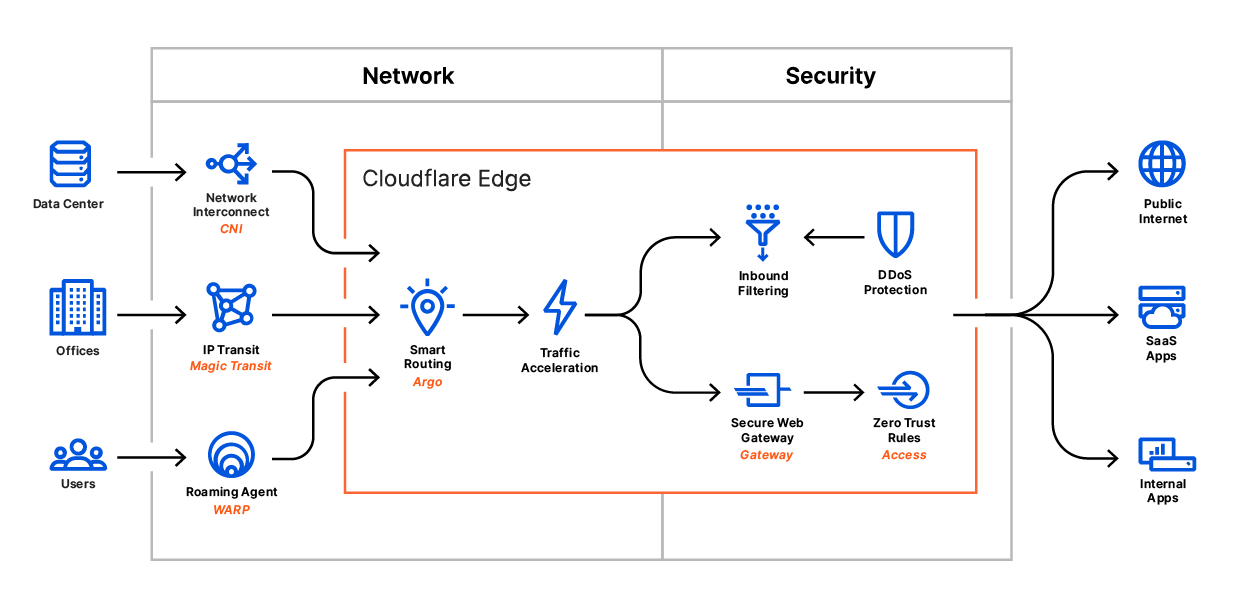
In practice, Cloudflare is placed between your browser and the actual hosting of the page.Operating as a reverse proxy, it receives user requests, decides which server to route them to, serves cached copies when possible, and filters suspicious traffic. It does all this by leveraging its own network of data centers deployed in hundreds of locations around the world.
At the business level, Cloudflare handles multi-million dollar figures.It has thousands of employees and generates hundreds of millions of dollars in annual revenue, although it has long posted net losses by prioritizing growth and network expansion. Its subsidiaries include companies and offices in Germany, Canada, Portugal, France, the Netherlands, Australia, Japan, India, the Middle East, and more.
Its growth has been fueled by several rounds of funding with investors such as Pelion Venture Partners, Venrock, New Enterprise Associates, Fidelity, Google Capital, Microsoft, Qualcomm or Baidu, who have contributed tens and then hundreds of millions of dollars to boost the expansion of the network and the development of new products.
How the Internet works and what a CDN like Cloudflare looks like
To understand what Cloudflare does, we need to briefly review how the Internet works.. Each site It resides on one or more servers, which are computers connected to the network. When you type a URL into your browser, your device sends a request to that server to receive the content (HTML, CSS, JavaScript, images, videos, etc.).
The problem arises when that server, or even a quality VPSIt is geographically very far away or it has to handle too many requests at once.If you have an online store hosted on a single server in your country, users connecting from your region will have reasonably fast access, but someone on the other side of the world may notice much slower speeds, outages, or even inability to access the site under certain conditions.
Furthermore, concentrating all traffic on a single server is a perfect recipe for bottlenecks.If thousands or millions of users try to log in at the same time, the machine becomes overloaded, latency increases, and the page starts to lag or directly return errors such as the famous 502 Bad Gateway.
This is where the concept of a Content Delivery Network (CDN) comes into play.A CDN is a network of servers distributed around the world that store copies of a website's static content (images, JS and CSS files, cached pages, etc.) and respond to users from the nearest location. This way, instead of crossing an ocean to reach the origin server, your browser communicates with a nearby node that serves the content much faster.
CDNs are now a fundamental part of the Internet architectureEspecially for streaming services, online video games, major media outlets, social networks, and any website with international traffic. They guarantee lower latency, greater availability, and the ability to handle traffic spikes without the main server crashing.
Cloudflare as a CDN… and much more

Cloudflare initially became popular as a CDN “for the masses”It's accessible and easy to set up, even for small projects. You can create a free account, delegate your domain to their DNS, and in just a few minutes, have your site running from their global network of data centers with minimal effort on your original server.
Once activated, Cloudflare acts as a reverse proxy and content delivery networkThis means it receives traffic destined for your domain, caches static content, and, when possible, responds directly without bothering the origin server. This saves CPU, memory, and bandwidth resources on your hosting, and your site typically runs faster and more efficiently.
But the beauty of Cloudflare is that it didn't just remain a CDNThe company added security and optimization services: protection against distributed denial-of-service (DDoS) attacks, web application firewall (WAF), anti-bot rules, spam limitation, malicious traffic inspection, and specific solutions designed for large companies and critical infrastructures.
Their catalog also includes high-performance DNS servicesThe public DNS servers 1.1.1.1 and 1.0.0.1 were presented as a fast and privacy-respecting alternative for users. Furthermore, for customers hosting their domains with Cloudflare, the company manages millions of DNS records with some of the fastest resolution times in the industry thanks to its distributed Anycast network.
Over time, Cloudflare has ventured into areas such as edge computing. With products like Cloudflare Workers and Workers KV, which allow serverless code to run directly on its globally distributed nodes, it has also launched platforms such as Cloudflare Pages (for static Jamstack sites), zero-trust enterprise access solutions (Cloudflare for Teams, Access, and Gateway), and an end-user VPN called Warp.
Main services offered by Cloudflare
Although Cloudflare's ecosystem is enormous, its services can be grouped into several basic areas. that help to understand what it contributes to a website or an online application.
Content Delivery Network (CDN)
Cloudflare's CDN is based on a global network with hundreds of locations in over 100 countriesThis network caches static website content (images, stylesheets, scripts, cached HTML pages, etc.) and delivers it from the server closest to the end user to reduce latency and speed up loading.
For a user in Spain visiting a website originally hosted in the United StatesThis means your browser doesn't have to "cross the pond" with every request: Cloudflare responds from a nearby data center (Madrid, Lisbon, Paris, etc.), making the experience much smoother and consuming fewer resources on the origin server.
This geographical distribution also increases resilienceIf one data center experiences problems, traffic can be automatically redirected to another without any user intervention. Therefore, for many companies, relying on Cloudflare is essentially a way to gain resilience against occasional outages of their own servers.
Protection against attacks and web application firewall (WAF)
One of Cloudflare's biggest draws is its ability to stop DDoS attacks and other types of threatsBeing in the middle of all the traffic, it can analyze patterns, detect anomalous behavior, and block malicious requests before they reach the real server.
Its web application firewall (WAF) includes rules based on OWASP ModSecurity and its own rule sets to block typical attacks such as SQL injection, cross-site scripting (XSS), or attempts to exploit known vulnerabilities in popular CMSs and frameworks. For many sites, this provides a valuable layer of defense that complements the hosting provider's security measures.
In the field of DDoS mitigation, Cloudflare has played a leading role in some of the largest attacks on record.It has been able to absorb attacks of hundreds of Gbit/s targeting media outlets, organizations, and various services, maintaining legitimate traffic while filtering out malicious packets.
DNS services and performance
Cloudflare offers DNS for both customer domains and general public use.Its Anycast network allows DNS requests to be resolved at the nearest node, further reducing loading times for websites using its platform.
In addition to speed, Cloudflare's DNS incorporates protection mechanisms Against attacks targeting name servers: flood filters, query validation, multi-location response, etc. This makes it a popular choice not only for its performance but also for its reliability.
Encryption, SSL/TLS and web optimization
Cloudflare provides free SSL/TLS certificates for domains that pass through its networkThis ensures that traffic between the user's browser and Cloudflare is encrypted. Depending on the configuration, the segment between Cloudflare and the origin server can also be encrypted, providing a complete encryption chain.
In terms of performance, it incorporates automatic optimization options. This includes minifying CSS and JavaScript resources, compressing images, using HTTP/2 and HTTP/3, supporting HTTP/2 Server Push, and configuring smart caches. All of this helps reduce loading times and improve scores in web performance tools.
Advanced solutions: edge computing, Zero Trust and more
Beyond the traditional web, Cloudflare has been building an entire platform for developers and businessesWith Workers, you can deploy serverless functions that run on your edge nodes; with Workers KV, you have a low-latency distributed key-value store; with Pages, you can deploy static sites without managing servers.
In the corporate sphere, Cloudflare for Teams integrates two major components.Gateway, a configurable DNS resolver to control and filter an organization's outbound traffic, and Access, a zero-trust access system that replaces traditional VPNs through authentication and access policies based on identity and context.
Why does it seem like half the internet goes down when Cloudflare goes down?
The downside of this enormous success is global dependenceWhen a significant part of Cloudflare's infrastructure fails, the consequences cascade across thousands or millions of services that rely on its network to function normally.
There have been instances where internal changes or configuration errors have caused massive outages.A recent example was a global outage in November, which affected services as varied as ChatGPT, X (Twitter), Canva, League of Legends, Spotify, banks, media outlets, and numerous smaller websites. For several hours, many of these sites were inaccessible or functioned erratically.
In one of these incidents, Cloudflare's CEO himself explained the origin of the problem.A change in permissions on one of their database systems caused multiple entries to be generated in a feature file that fed the bot management system. That file doubled in size and propagated to all machines on the network, causing an unexpected overload that led to a service outage.
When this happens, users see errors such as 502 Bad Gateway When trying to access websites that use Cloudflare, you might encounter issues. In these cases, the problem is usually not with the website or online store itself, but with the underlying network infrastructure. Monitoring platforms like DownDetector can help determine if the problem is widespread or only affecting you.
From the end user's point of view, there's little that can be done. If Cloudflare's network, or a part of it, has gone down, all that's left is to wait for the company to identify and fix the problem. The company has publicly acknowledged on several occasions that outages of this kind are "unacceptable" and has promised to strengthen its systems to prevent them from happening again.
Services that use Cloudflare and the actual reach of your network
The list of services that depend to a greater or lesser extent on Cloudflare is overwhelming.We're talking about social networks, cryptocurrency exchanges, streaming platforms, online stores, software providers, banks, public administrations, and much more.
Among the clients and projects that have been or are currently being used by Cloudflare are: Medium, ThemeForest, Discord, Coinbase, HitBTC, e-commerce sites on Shopify, SoundCloud, Dropbox, Pinterest, plus major brands like X, Bluesky, Microsoft, Mozilla, Snapchat, Temu, news agencies like EFE, Wikipedia/Wikimedia, banking entities like CaixaBank, consumer organizations, etc.
In the area of DNS, it is estimated that Cloudflare manages the names of millions of domains.with tens of thousands of new sites joining daily. Its public DNS 1.1.1.1 has also become popular among individual users seeking speed and greater privacy compared to their ISP's resolvers.
The industry itself recognizes Cloudflare as one of the key players in internet infrastructure.It has received awards such as TechCrunch's "Best Enterprise Startup", has been named several times among the most innovative companies in the world by media such as the Wall Street Journal or Fast Company, and is listed in rankings such as the Forbes Cloud 100.
Controversies: freedom of expression, illegal content, and criticism
Cloudflare's position as an intermediary has placed it at the center of several controversies. related to freedom of expression, content moderation, and the use of its infrastructure by extremist or directly criminal groups.
For years, the company has maintained a position of neutrality.claiming that it is an infrastructure provider and not a traditional hosting provider, and that, therefore, it should not act as an arbiter of the content that passes through its networks except when the law is clearly violated and it receives specific legal requirements.
However, there have been documented cases where Cloudflare has provided services to far-right websites.Forums related to hate speech, groups designated as terrorists by the United States, and organizations that facilitate crimes such as doxing, the sale of stolen data, or the distribution of illicit material.
Frequently cited examples include the temporary protection of websites such as The Daily Stormer or 8chan...or technical support for forums like Kiwi Farms, linked to systematic harassment campaigns against transgender people and other vulnerable groups. In several cases, public pressure, media coverage, and extremely serious incidents (such as mass shootings or suicides related to this harassment) led Cloudflare to cut off its services to these sites.
Organizations and academic studies have criticized Cloudflare's moderation policy for sometimes being too lax.This allowed a significant portion of the infrastructure for disinformation, hate speech, and piracy to rely on its network. European reports have even included the company on lists of “notorious markets” for indirectly facilitating counterfeiting and copyright infringement.
Cloudflare, for its part, argues that it complies with the law and cooperates with authorities. when it receives official requests, and that its business model is not "protecting criminals," but rather offering security and performance services to those who contract its infrastructure. Even so, the debate about the extent of the responsibility of this type of provider remains very much alive.
Cloudflare, carriers, and content blocking
Another controversial issue arises when courts order the blocking of pirate services that rely on Cloudflare.In some countries, court rulings have led operators to block IP ranges associated with the company to stop illegal retransmissions of football or other protected content.
A recent case in Spain clearly illustrates the problem.Following a court ruling related to pirated LaLiga broadcasts, telecom companies were asked to block Cloudflare IP address ranges used by illegal IPTV platforms. As a side effect, entirely legitimate services sharing that infrastructure were also affected, from X and Vimeo to Steam, GitHub, and even the website of the Royal Spanish Academy.
Situations like this show the risks of attacking infrastructure when trying to prosecute illegal projectsSince Cloudflare is a widely used provider, an indiscriminate block leaves countless services in the dark that have nothing to do with the targeted activities, generating considerable collateral damage.
How can a web project use Cloudflare and what advantages does it offer?
For a web developer or a small business, Cloudflare can represent a significant leap forward. in security, speed, and resource consumption of hosting, especially if you are creating or want Make a web pageIt integrates as an additional layer without needing to change hosting providers.
Basic activation usually involves creating an account and adding the domain.You can let Cloudflare import your existing DNS zone and then delegate the domain's nameservers to those provided by the platform. From there, you can choose which records pass through the Cloudflare network (typically the primary A record and the "www" subdomain at a minimum).
Many hosting plans already include built-in tools to activate Cloudflare with just a few clicks.without having to manually adjust the settings much. Once up and running, you'll notice that the server's CPU, memory, and bandwidth usage decreases because a large portion of the static resources are served from the CDN cache.
For modest projects, Cloudflare's free plan is usually sufficient. To benefit from the CDN, free SSL, fast DNS, and a basic layer of security. From there, paid plans add advanced WAF, custom rules, more optimization options, detailed analytics, and professional support.
If your carrier or country blocks access to Cloudflare at any timeThe practical consequence is that you will lose access to many of the sites that use it, even if they are working perfectly. In these cases, one way to bypass the block is to use a VPN to connect through an IP address in another country where this restriction does not exist.
Cloudflare has become a kind of "invisible backbone" of the InternetIt speeds up websites, protects them from attacks, offers modern tools for developers and, at the same time, raises very serious debates about dependence, concentration of power and responsibility for the content that circulates through its network.