- Ability to transform detailed textual descriptions into high-quality, high-resolution visual pieces up to 4K.
- Diversity of models and workflows that allow you to create everything from individual images to complex visual projects.
- Access to free tools and commercial use options under flexible copyright regulations.
- Implementation of security and moderation systems to ensure the creation of content suitable for all audiences.
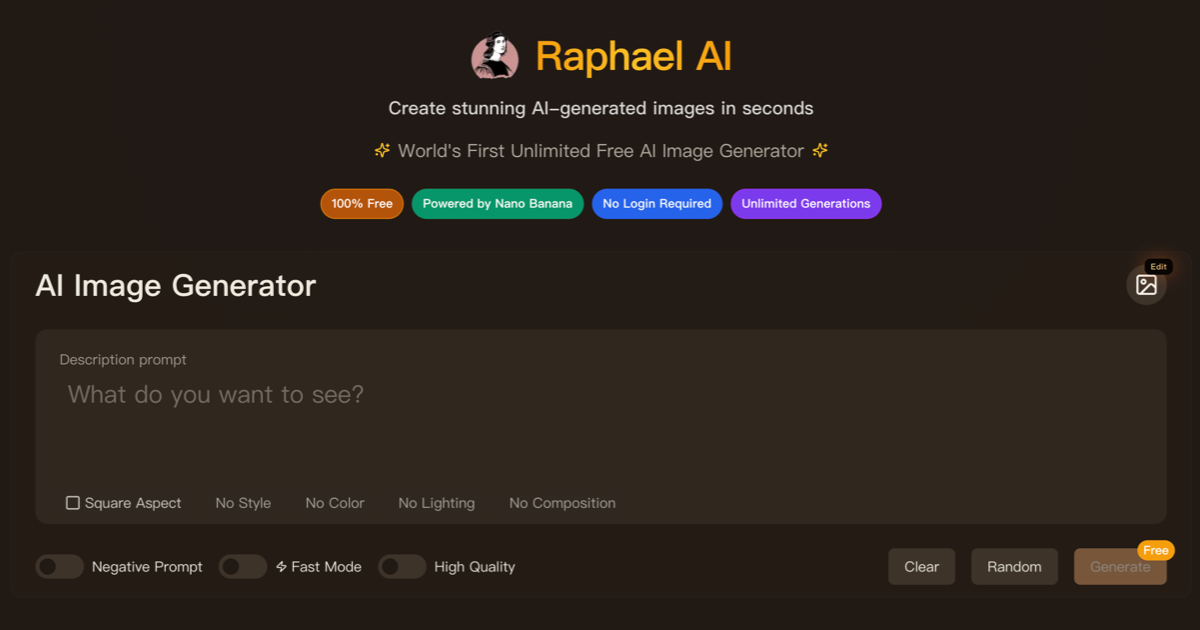
Today, creating visual content no longer requires spending hours wrestling with complicated design programs. Thanks to the rise of artificial intelligence, anyone can turn a simple written idea into a digital work of art in a matter of seconds, democratizing creativity in a way that seemed like science fiction just a few years ago.
Whether you're looking for an illustration for your blog, a graphic for a professional presentation, or simply want to experiment with your imagination, these tools offer an endless array of possibilities . The most amazing thing is that we're no longer limited to a single image, but can develop complete workflows that integrate cohesive visuals for entire projects.

What exactly is an AI image generator and how does it work?
Basically, it's advanced software that uses machine learning techniques to interpret human language and translate it into pixels. These tools don't draw from scratch like a human; instead, they've been trained by scanning millions of images and texts from the web, allowing them to predict which visual elements best match the words you type.
The magic happens through the use of diffusion models or transformers . When you input text, the AI synthesizes a new image that can range from a photorealistic style to something much more painterly or abstract, depending on the engine behind it. It is, in essence, a machine for translating concepts into vibrant and detailed images .
Access options and available models
In today's market, there are various access philosophies. On the one hand, we have platforms that offer generous free tiers , allowing new users to try the tool with initial credits or daily fees that make the service virtually unlimited for the average user, thus avoiding annoying immediate paywalls.
Furthermore, versatility is key. While some websites focus on a single model, others act as a unified workspace where you can switch between dozens of different engines (such as Z-Image Turbo or Grok Imagine) to compare results. This is vital because each AI engine interprets prompts differently, giving you more control over the final aesthetic.
The art of writing the perfect prompt
If you want the AI to stay on track and give you exactly what you're looking for, simply typing "a dog" isn't enough. The secret lies in being extremely specific . You must detail the subject, the environment, the lighting, the camera angle, and even the mood of the scene. For example, it's much more effective to ask for a cinematic portrait with depth of field and film grain than a generic description.
Another expert trick is using negative prompts . This allows you to explicitly tell the tool which elements you DON'T want to appear in the image, thus cleaning up the final result. Remember that the generator rewards detail and precision , so the richer your description, the more impactful the image will be.
Technical quality, resolutions and formats
The quality has taken an incredible leap. We're no longer satisfied with small images; now it's possible to get 4K resolution output , which is essential if you plan to print posters, design book covers, or create professional merchandise without the image becoming pixelated.
Regarding file formats, JPG, WebP, and PNG are the most common . PNG is especially useful when you need transparent backgrounds for logos or overlay elements in web design. Furthermore, the response speed is astonishing, achieving results in a time that typically ranges between 5 and 15 seconds.

Commercial use, legality and copyright
This is an area where there is still considerable global debate. Generally, many platforms do not claim ownership of the generated images, allowing users to use them on social media, in advertisements, or in business presentations. However, it is crucial to read the terms and conditions, as copyright law varies from country to country.
It's important to recognize that, while the final work may be unique, the AI has been trained on data that often belongs to human artists . This raises ethical and legal questions about copyright infringement, an issue the legal community continues to grapple with as laws attempt to keep pace with technology.
Security, ethics, and content moderation
To prevent these tools from being used for malicious purposes, most reputable generators implement strict security measures . This includes automatic filters that block keywords related to adult content, violence, or explicit material (NSFW), ensuring the platform is a safe and family-friendly creative space.
Privacy is also a critical issue. The most transparent platforms ensure that images uploaded for reference or written prompts are not used to train their models without the user's explicit consent, thus protecting the intellectual property of the creator.
Advanced features: From image to video and more
Evolution doesn't stop at static images. Currently, it's possible to use picture-in-picture mode , where you upload your own photo and the AI uses it as a basis for composition, color palette, or pose. It's an amazing tool for redesigning existing photos or giving them an artistic twist.
And if you want to take things to the next level, there are already workflows that allow you to convert those images into animated video clips of several seconds. This transforms the experience into a complete creative ecosystem where you can manage audio, video, and images from a single panel, optimizing the production time of any visual project.
Today we have tools capable of generating everything from futuristic aesthetics with neon lights and reflective surfaces to minimalist illustrations, all without the need for mandatory registration in many cases and with a processing speed that allows infinite iteration until the perfect result is achieved.